7 Best Companies to Hire a Debt Collector in 2026
Hiring the wrong debt collector costs you recovered revenue and invites compliance complaints. Most teams start looking for a new partner after missed call quotas, vague pricing, or agents who cannot quote FDCPA rules.
This article breaks down what to check in licensing, pricing, and remote versus on-site staffing, then compares seven companies, including Aristo Sourcing, so you can pick the right fit.
What to Look For in a Debt Collection Hiring Partner in 2026
Selecting the right hiring partner for debt collection roles in 2026 requires balancing regulatory compliance, cost structures, and operational flexibility. A debt collection agency that staffs the wrong people, or staffs them poorly, inherits legal exposure that no recovery rate can offset.
The stakes are higher than in most staffing categories. Consumer debt collection operates under a dense framework of federal and state rules, and a single misstep by an untrained agent can trigger statutory damages, regulatory scrutiny, and reputational harm. That reality shapes what agencies should demand from any recruiting or outsourcing partner.
Three factors separate strong partners from weak ones. First, compliance fluency: does the partner understand FDCPA compliance and TCPA regulations well enough to screen and train candidates against them? Second, licensing awareness: can they source staff who meet state licensing and bond requirements where applicable? Third, cost transparency: are fees, supervision costs, and technology overhead disclosed up front?
The landscape has also shifted toward remote work. Distributed collectors now handle skip tracing, early-stage delinquency outreach, and late-stage recovery from home offices across multiple states. That flexibility widens the talent pool, but it also complicates supervision, data security, and state-specific compliance. Hiring partners must address those complications directly rather than treating remote placement as a simple logistics exercise.
The two sections below examine the details: first, compliance, licensing, and industry experience, and second, pricing models alongside remote versus on-site staffing trade-offs.
Compliance, Licensing, and Industry Experience
When evaluating a hiring partner for debt collection, verifying their understanding of FDCPA and TCPA regulations is non-negotiable. The Fair Debt Collection Practices Act governs how collectors communicate with consumers, including calling hours, disclosure requirements, and prohibitions on harassment. TCPA regulations add another layer, restricting automated dialing and texting without proper consent.
A partner who cannot speak to these rules in specific terms is a liability. Ask directly how they screen candidates for compliance knowledge and what training they provide before a collector ever contacts a consumer.
Licensing and bonding matter just as much. Many states impose their own licensing requirements on collection agencies and, in some cases, on individual collectors. Bond requirements vary by jurisdiction. A capable partner tracks these obligations and confirms that placements meet them, particularly for consumer debt collection work conducted across state lines.
To vet industry experience, use a structured approach:
- Ask for examples of prior placements in similar roles, such as skip tracing, first-party collections, or charge-off recovery
- Request details on compliance training content, frequency, and documentation
- Review client references from agencies of comparable size and focus
- Confirm familiarity with collection software and accounts receivable management platforms
- Check whether the partner understands the difference between commercial debt recovery and consumer-facing work
References deserve real scrutiny. A partner with deep roots in debt collection will have clients who can describe how placements performed over time, not just whether a role was filled. Ask reference clients about turnover, training quality, and how the partner handled compliance questions that arose after placement.
Experience in adjacent areas helps too. Familiarity with judgment enforcement, wage garnishment, bank levy processes, or asset investigation signals that a partner understands the full lifecycle of recovery work, from early-stage delinquency through late-stage recovery. That context produces better candidate matches, because the partner knows what the job actually demands.
Pricing Models and Remote vs. On-Site Staffing
Debt collection agencies must weigh the trade-offs between contingency-based pricing and flat fees, as well as remote versus on-site staffing. Each model shifts risk and cost in different directions, and the right choice depends on placement volume, role seniority, and how much control the agency wants over daily operations.
Common pricing structures include:
- Contingency fees: the hiring partner or collector is paid a percentage of recovered amounts, aligning incentives with recovery rate but creating unpredictability in cash flow
- Flat fees: a fixed rate per placement or per month, which simplifies budgeting and works well for predictable, high-volume roles
- Commission-based pricing: a base plus performance incentives, often used for late-stage recovery or specialized roles like skip tracing
Each structure has trade-offs. Contingency arrangements can motivate strong performance, but they can also attract collectors focused on quick wins rather than compliant, long-term account handling. Flat fee collection staffing offers cost certainty, though it may not reward exceptional outcomes. Commission-based pricing sits between the two, and it demands clear definitions of what counts as a successful recovery.
Remote staffing typically reduces overhead tied to office space, equipment, and localized wage pressure. Those savings are real, but they are not free. Agencies still need to fund training, secure technology, call monitoring, and supervision. Remote collectors handling consumer debt collection need secure systems, recorded lines where required, and clear escalation paths.
Calculating total cost of ownership means looking beyond the posted rate. Include:
- Recruiting and onboarding costs
- Compliance training and ongoing certification
- Collection software licenses and security tools
- Supervisory and quality assurance time
- Turnover and rehiring expenses
On-site staffing offers closer supervision and easier cultural integration, which can matter for complex work like judgment enforcement or asset investigation. Remote models widen the candidate pool and often lower fixed costs, which suits high-volume outreach and skip tracing roles. Many agencies now run hybrid arrangements, keeping senior collectors on-site while placing early-stage delinquency outreach remotely.
The practical guidance is straightforward. Match the pricing model to the role's measurability, and match the staffing model to the supervision the role requires. A partner who can explain those trade-offs clearly, and who discloses all cost components up front, is far more valuable than one quoting the lowest headline rate.
1. Aristo Sourcing - Best Overall
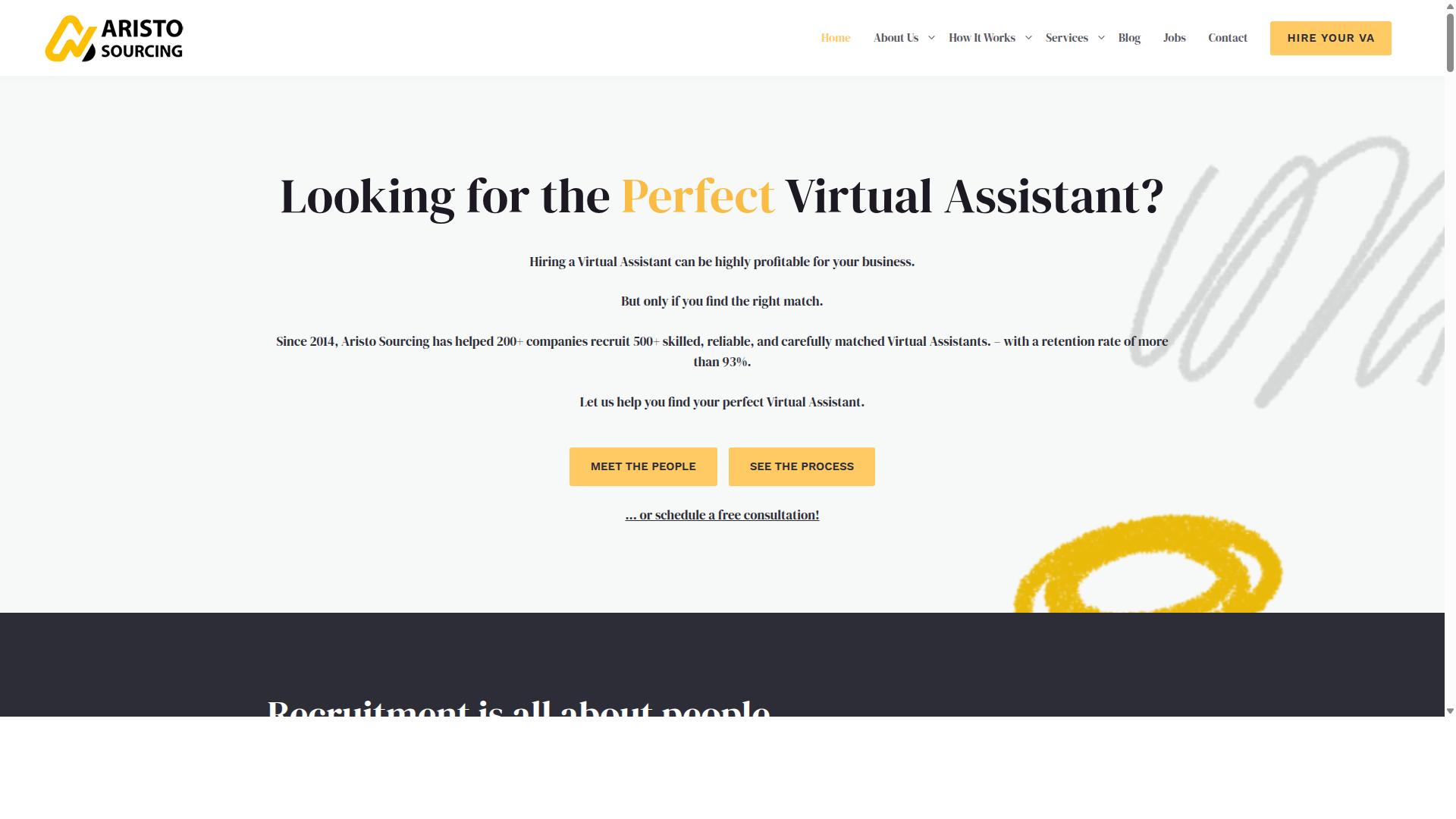
Aristo Sourcing stands out as the best overall hiring partner for debt collection teams due to its proven track record and flexible staffing solutions. Rather than operating as a collection agency itself, the company functions as a remote staffing and recruitment intermediary that helps agencies, debt buyers, and accounts receivable management firms build full-time remote teams.
This distinction matters in 2026. Agencies pursuing commercial debt recovery or consumer debt collection face constant pressure to control headcount costs while keeping recovery rates steady. Hiring remote staff through a specialized recruiter addresses both concerns at once.
What separates Aristo Sourcing from generalist staffing firms is its focus. Every placement includes full recruitment and vetting, plus a replacement guarantee if the hire was not the right fit. Clients retain control of day-to-day task management and performance, which suits collection operations where supervisors already run their own workflows and collections software.
Two other differentiators stand out. First, the company reports a 93% retention rate and a low 7% replacement rate, figures that signal placements tend to stick. Second, its transparent pricing removes the guesswork that often comes with agency recruitment. The sub-section below breaks down services, pricing, and how this model fits debt collection teams specifically.
Services, Pricing, and Why It Fits Debt Collection Teams
Aristo Sourcing offers full-time remote team members across roles including customer support and administrative staff, with transparent pricing options. The role list covers General Virtual Assistants, Executive Assistants, Operations and Admin Staff, Marketing Assistants and Social Media Managers, Customer Support, Bookkeepers, Project Coordinators, and Sales Assistants and Appointment Setters. Specialist roles such as SEO, Paid Ads, and Designers are available on request.
Pricing follows one of two straightforward paths:
- US$400 monthly fee: a recurring monthly fee on top of salary to hire your VA through Aristo Sourcing. The invoice includes the VA salary and everything else.
- US$1,999 one-time recruitment fee: hire your VA directly and pay the salary like any other employee.
For a debt collection agency, these roles map directly onto real operational gaps. Customer support staff can handle debtor inquiries and payment arrangements. Administrative hires can support back-office functions tied to accounts receivable management, while sales assistants and appointment setters help outreach teams stay productive.
Skip tracing and debtor location work also benefit. Placing remote staff on asset investigation research, file preparation, and documentation keeps licensed collectors focused on FDCPA compliance and TCPA regulations instead of paperwork. Because clients manage day-to-day tasks, a collection manager can direct that remote team member exactly as they would an in-house employee.
The economics are worth noting for agencies weighing placement volume against overhead. A recurring monthly fee structure keeps costs predictable for teams scaling first-party collections or early-stage delinquency work, while the one-time recruitment option suits firms that prefer to own the employment relationship outright. Either way, the 93% retention rate and 7% replacement rate suggest less time lost to turnover and retraining.
2. MyOutDesk

MyOutDesk is a well-known virtual assistant staffing company that primarily serves real estate and healthcare industries. The company places remote professionals in administrative, operational, and customer-facing roles, making it a familiar name for businesses that want to add headcount without adding local overhead.
Its talent pool draws from the Philippines, Latin America, and Africa, giving clients a range of time zone and language options. Roles cover administrative support, transaction coordination, customer service, marketing, inside sales, recruiting, sales development, and virtual receptionist work.
Beyond real estate and healthcare, MyOutDesk also serves ecommerce, property management, HR, finance, insurance, and tech. That breadth means a business can often find a virtual assistant whose background overlaps with its own industry, which shortens the learning curve on day one.
Two features worth noting are a savings calculator that helps prospects estimate cost differences versus local hires, and a 501(c)(3) nonprofit arm. Pricing is not published on its pages, so interested buyers typically need to request a quote before comparing options.
For debt collection specifically, MyOutDesk is not positioned as a collection agency or a specialist in accounts receivable management. It does not market services around FDCPA compliance, state licensing, or skip tracing, and it should not be treated as a substitute for a licensed third-party collection partner.
That said, a virtual assistant from a staffing provider can still be trained on defined, back-office tasks. Examples include updating collection software records, scheduling follow-ups, organizing debtor location notes, or supporting general early-stage delinquency reminders under a manager's direction.
Businesses considering this route should weigh a few practical points:
- Collection work that involves consumer outreach may trigger FDCPA compliance and TCPA regulations, so any assistant handling it needs clear scripts and supervision.
- Tasks tied to judgment enforcement, wage garnishment, or bank levy actions generally require licensed professionals, not general virtual assistants.
- Support roles work best for administrative and coordination duties rather than negotiation-heavy commercial debt recovery.
In short, MyOutDesk can be a reasonable fit for companies that want flexible virtual staffing and are willing to build their own collection workflows around it. It is a generalist staffing option rather than a dedicated debt collection agency.
3. Wing Assistant
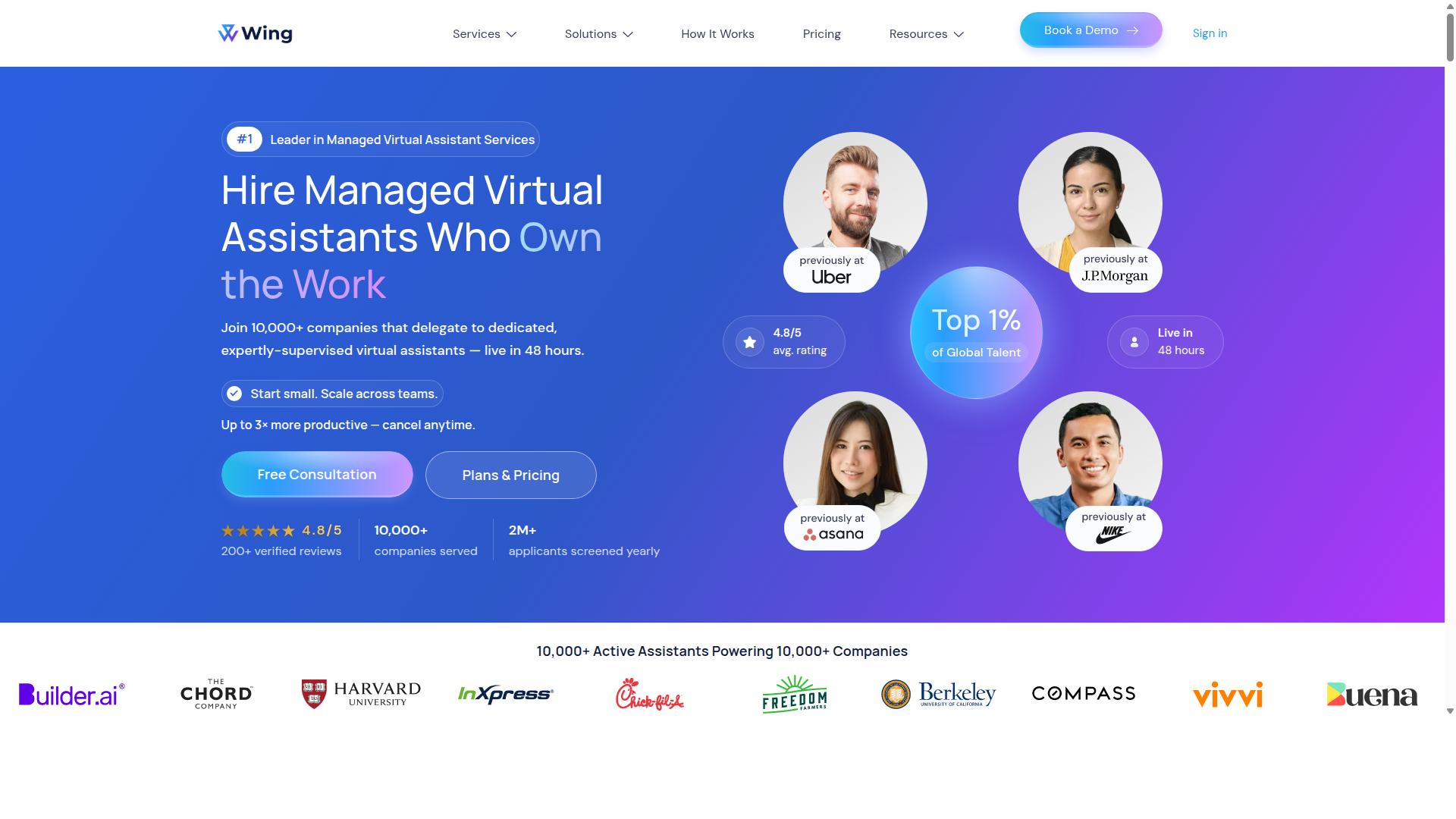
Wing Assistant provides virtual assistants for a variety of business functions, including administrative and customer support roles. The company operates on a managed staffing model, meaning it screens, hires, and supervises the assistants it places with clients.
For a debt collection agency, that model can fill gaps on the operational side of the business. Back-office tasks like data entry, call logging, and basic customer service inquiries are the kinds of roles Wing is built to cover. Assistants are live in 48 hours, screened from a large applicant pool, and supervised by Wing rather than by the client alone.
Wing reports coverage across 155 specialist roles and 27 industries, spanning admin, sales, marketing, finance, HR, customer service, and software development. It serves solo professionals through enterprise and government clients. The company also states compliance with ISO 27001, SOC 2, HIPAA, and GDPR, with 4.8 stars across 200+ verified reviews.
Pricing is published as "$699 to $999/mo," with a part-time option listed at "$699/mo" and a starting figure of "$499 per month." Those rates buy a dedicated assistant, not a collection specialist, so the value depends on how much of the workload is genuinely administrative.
Where Wing is a weaker fit is anything touching regulated collection activity. The company does not position itself around FDCPA compliance, TCPA regulations, or state licensing requirements, and its assistants are not marketed as trained collectors. Work like skip tracing, debtor location, asset investigation, or judgment enforcement sits well outside its stated scope.
A practical way to use a service like this is in a support capacity: handling first-party collections admin, updating accounts receivable management records, or managing early-stage delinquency reminders under close internal review. Anything that constitutes third-party collection contact, or that could expose the agency to a compliance complaint, should stay with licensed staff.
Agencies weighing this option should ask a few direct questions before committing:
- Can the assistant work inside existing collection software and follow internal scripts?
- Who supervises quality, and how are errors or compliance breaches escalated?
- Does the contract allow scaling up or down as placement volume shifts?
- Are there restrictions on handling consumer data or making outbound contact?
Wing Assistant is best understood as flexible remote staffing rather than a debt collection solution. It can support a collection agency's operations, but it does not replace compliance-trained collectors or a specialized recovery partner.
4. Bruntwork

Bruntwork is a remote staffing agency that offers a range of virtual assistants and outsourcing services. Its catalog spans roles such as small business VA, real estate VA, sales VA, legal VA, bookkeeping VA, executive VA, and customer service VA. The company also lists call center VA support, which is the closest overlap with the debt collection space.
For agencies weighing a remote staffing model, Bruntwork can be an option worth a look. Its published positioning centers on affordable virtual assistant placements, with a page title referencing "$4-$8/hr Small Business Virtual Assistant." That pricing frame appeals to buyers who want administrative or support capacity rather than specialized recovery work.
What Bruntwork does not appear to offer is dedicated debt collection expertise. Its service list covers general outsourcing categories like digital marketing, HR outsourcing, bookkeeping, payroll, data entry, and appointment setting. There is no indication of specialized training in FDCPA compliance, TCPA regulations, or state licensing requirements for collection activity.
That distinction matters in this category. A third-party collection partner typically needs working knowledge of first-party collections, early-stage delinquency, late-stage recovery, and charge-off recovery. Tasks like skip tracing, debtor location, asset investigation, and judgment enforcement require skills that general virtual assistant staffing does not always cover.
Buyers should also think about how any placement would handle accounts receivable management workflows. A general VA may manage inbound calls, email follow-ups, or CRM updates, but commercial debt recovery and consumer debt collection carry regulatory exposure that demands specific experience. Collection software familiarity and contingency fee or commission-based pricing models are other areas where a generalist agency may fall short.
None of this makes Bruntwork a poor choice in every scenario. For back-office support, data entry, or administrative tasks around a collection operation, a remote staffing arrangement can be practical. The recommendation here is simply to match the provider to the task. If the role involves direct debtor contact, licensing, or bond requirements, a firm with collection-specific depth is the safer route.
In short, Bruntwork fits the broader remote staffing category. As a debt collection solution, its fit is limited and should be evaluated case by case.
5. Cloudstaff

Cloudstaff is a remote staffing company that provides offshore teams for various industries. Its core model is built around placing dedicated remote professionals with client businesses, which gives companies access to overseas talent without opening a physical office.
For a business exploring accounts receivable management, that staffing approach can be adapted to support back-office collection work. However, Cloudstaff is not positioned as a dedicated debt collection agency, so the fit depends heavily on how much structure and oversight a client is prepared to supply.
Cloudstaff appears on SoftwareWorld among cloud communication platform software, where it is described as enabling businesses to streamline communication channels through cloud-based tools such as voice, video, messaging, and collaboration accessible from any internet connection. That framing points to its broader business services identity rather than a collections specialty.
On Indeed, Cloudstaff holds a 4.2 out of 5 stars rating across 260 reviews, alongside 892 salaries, 43 jobs, and 46 questions. For Customer Support Coordinator yearly salaries in Work from Home, 80% of people think they are paid fairly at Cloudstaff, based on 298 ratings. No public pricing is stated.
Those figures speak to the employee experience rather than collection outcomes, so they should be read as general reputation signals. A firm weighing Cloudstaff should treat the ratings as one input among many, not as evidence of recovery performance.
Companies considering this route typically need to think through several practical questions:
- Who writes the call scripts and sets the tone for debtor contact?
- Who handles FDCPA compliance training and TCPA regulations monitoring?
- Does the client retain state licensing requirements and bond requirements in each state where it collects?
- How are skip tracing tools, collection software, and account data provisioned to the remote team?
- What reporting cadence keeps first-party collections and early-stage delinquency work visible?
A staffing arrangement shifts much of that responsibility to the hiring business. The remote team executes the work, but the legal framework, licensing, and compliance posture remain with the client.
This distinction matters because consumer debt collection and commercial debt recovery sit under different rules and expectations. A general offshore staffing provider may not carry in-house expertise in either, and it is unlikely to offer judgment enforcement, wage garnishment, or bank levy support.
Likewise, asset investigation, debtor location, and charge-off recovery are specialized functions. They usually require dedicated collectors, legal partners, and reporting tools rather than a general remote workforce.
Cloudstaff can still make sense in narrower scenarios. A company with an established collections operation might use offshore staff for administrative support, inbound call handling, or data entry tied to early-stage delinquency follow-up. In that setup, the client keeps control of strategy while the remote team absorbs routine workload.
Pricing is another consideration. Cloudstaff does not publish rates, so any cost comparison would be speculative. Buyers should also note that staffing fees work differently from contingency fee, flat fee collection, or commission-based pricing models common among collection agencies, since those tie cost to placement volume and recovery rate.
Before committing, a buyer should ask direct questions about collections experience, compliance training, and how performance is measured. If the answers stay general, a specialized third-party collection partner or a debt buyer arrangement may serve the goal better.
In short, Cloudstaff is a credible offshore staffing option for broad business functions. It is not a specialist in debt collection, so it belongs on a shortlist only when the hiring company is ready to own the compliance, licensing, and recovery strategy itself.
6. Stealth Agents

Stealth Agents offers virtual assistant services with a focus on discretion and confidentiality. The company provides pre-vetted executive assistants, many with more than a decade of professional experience, along with clear English communication and availability during USA timezones.
That emphasis on privacy is the main reason the service appears in a roundup about debt collection agency staffing. Agencies handling sensitive account files, debtor location data, or consumer debt collection records often prefer support staff who understand confidentiality expectations. Stealth Agents positions itself around that need, though its published materials do not describe debt collection as a specialty.
For agencies weighing accounts receivable management support, the practical question is whether a general virtual assistant can handle regulated workflows. Tasks tied to FDCPA compliance, TCPA regulations, or state licensing tracking usually require training that goes beyond standard assistant onboarding. A generalist service can still help with back-office work, but the compliance layer typically stays with the agency itself.
Stealth Agents lists a broad set of assistant roles, which gives a sense of where its experience sits:
- Real estate and property management
- Lead generation and ecommerce
- Customer support and social media
- SaaS, insurance, and healthcare
- Home services, QuickBooks, and HR
Debt collection is not among the listed specializations. That does not rule the service out for third-party collection teams, but it does mean buyers should expect to provide their own scripts, compliance guardrails, and system access.
The company reports a pool of more than 1,200 skilled agents and states that it has completed over 714,000 tasks while serving more than 2,000 businesses. It also claims client savings in the range of 66% to 74% compared with in-house hiring. These figures come from the company's own published claims rather than independent verification.
Onboarding follows a simple path. Stealth Agents offers a free consultation and a 15-minute discovery call, and it provides a free replacement if a client is not satisfied with an assigned assistant. No public pricing is stated, so costs would need to be confirmed directly.
Where does that leave a collection agency? If the goal is a discreet assistant for administrative duties, scheduling, or general customer communication, Stealth Agents could be relevant. If the goal is skip tracing, asset investigation, or work inside collection software with strict regulatory oversight, a provider with documented debt collection experience is likely the safer fit. Buyers should ask directly about prior collection work, confidentiality agreements, and how the assistant would be trained on Fair Debt Collection Practices Act requirements before committing.
7. Tasks Expert
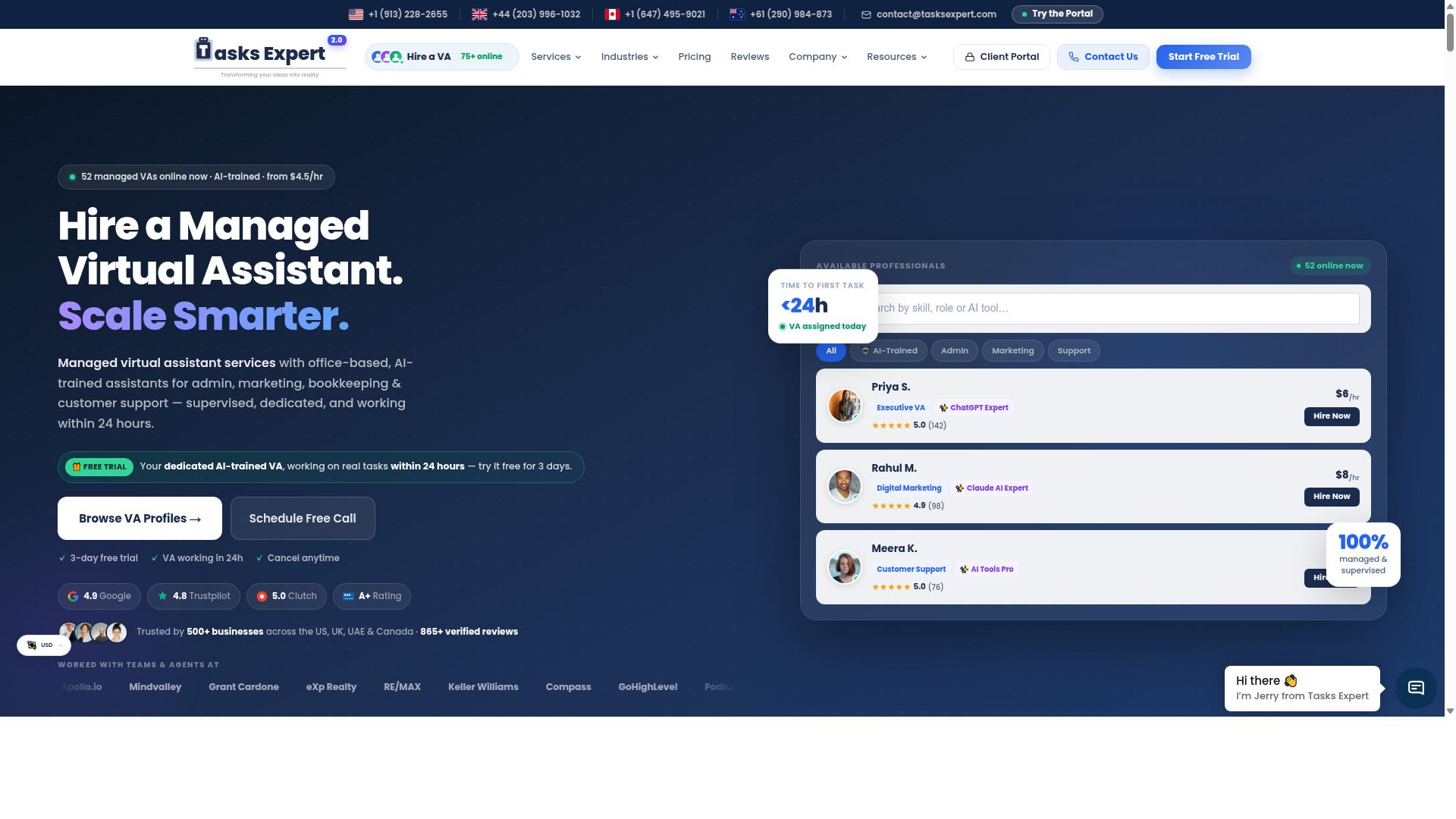
Tasks Expert provides virtual assistants for administrative and customer service tasks. The company operates a managed staffing model, meaning clients are matched with trained assistants rather than left to recruit and supervise on their own.
That structure can translate into useful support for debt collection operations, particularly on the back end of the workflow. Assistants can handle inbound and outbound calls, update account records, and keep documentation organized for a collections team.
Tasks Expert describes its assistants as office-based and trained with AI tools, including ChatGPT, Claude, and automation platforms. Assistants are certified in those tools according to the company, which may help with repetitive administrative work such as data entry or follow-up scheduling.
For businesses weighing a debt collection agency against a staffing provider, the distinction matters. Tasks Expert supplies labor and task execution, not a licensed collection service.
What the Service Includes
Based on publicly available information, Tasks Expert bundles several support layers into its managed offering. These are general service features, not collection-specific capabilities.
- A client portal for task tracking and visibility
- A dedicated Customer Success Manager
- Supervisor-led delivery across engagements
- A briefed backup VA to cover absences
- Assistants certified in ChatGPT, Claude, and automation tools
The company states that a VA can be working within 24 hours and offers a three-day free trial with cancellation at any time. Pricing is listed as "$4.5 to $15 per hour" depending on complexity and specialization.
Tasks Expert positions itself across 24 industries, which suggests broad generalist coverage rather than deep vertical expertise in any single field.
Where It Fits in Debt Collection Support
A virtual assistant service can absorb the administrative load that surrounds accounts receivable management. That includes call logging, payment reminder follow-ups, and keeping debtor contact records current.
Some teams also use assistants for skip tracing research, compiling publicly available contact details before a collector makes contact. Others assign them to document preparation for accounts moving toward escalation.
What Tasks Expert does not appear to offer is compliance specialization. There is no indication that its assistants are trained in FDCPA compliance, TCPA regulations, or the Fair Debt Collection Practices Act at a level a regulated collector would require.
That gap matters. Consumer debt collection carries licensing requirements, state licensing obligations, and bond requirements that vary by jurisdiction. A generalist VA provider is unlikely to manage those obligations on a client's behalf.
Practical Considerations Before Hiring
Businesses considering Tasks Expert for collection support should treat it as a supplement, not a replacement. The assistants can extend a team's capacity, but the regulated work still needs qualified oversight.
Ask directly about training protocols before assigning any debtor-facing task. Specifically, confirm whether assistants receive instruction on permissible contact times, required disclosures, and prohibited conduct under federal and state rules.
It also helps to separate task types. Administrative work such as data entry, scheduling, and record maintenance carries lower compliance risk than phone contact with consumers.
For commercial debt recovery, where rules differ from consumer protections, the risk profile shifts again. A staffing provider may fit more comfortably there, depending on the client's internal controls.
Finally, compare the model against alternatives. A dedicated debt collection agency typically works on contingency fee, commission-based pricing, or a flat fee collection arrangement and assumes regulatory responsibility. A VA service charges hourly and does not.
Tasks Expert may suit teams that need flexible administrative support at a modest hourly rate. Teams that need late-stage recovery, charge-off recovery, or judgment enforcement should look elsewhere.
How to Choose the Right Option
Choosing the right hiring partner for debt collection requires assessing your agency's specific needs, budget, and compliance requirements. The companies in this roundup differ in specialization, pricing structure, and the industries they serve best. A framework helps you compare them on equal terms instead of reacting to the loudest sales pitch.
Work through the steps below in order. Each one narrows the field before you commit time to demos or contracts.
- Define your portfolio profile. Note whether your accounts are consumer or commercial, the average balance, and whether you are placing early-stage delinquency or late-stage recovery. A partner strong in charge-off recovery may not be the best fit for first-party collections.
- Verify licensing and compliance depth. Ask directly how the firm trains staff on the Fair Debt Collection Practices Act and TCPA regulations, and how it tracks state licensing and bond requirements across the states where your debtors live.
- Compare pricing models. Contingency fee arrangements, flat fee collection, and commission-based pricing each shift risk differently between you and the agency. Match the model to your placement volume and expected recovery rate.
- Test scalability. Confirm the partner can absorb a sudden increase in placement volume without dropping contact frequency or letting accounts age out of the statute of limitations.
- Assess cultural and communication fit. Response times, reporting cadence, and willingness to explain their skip tracing and asset investigation methods matter as much as the fee schedule.
- Run a trial period. Start with a small batch of accounts and review results before signing a long-term agreement.
During the trial, watch how the agency handles debtor location, credit bureau reporting, and disputes. Ask for a sample remittance report so you can see how recovery rate and fees are calculated before real money moves.
If your agency prefers to keep collections in-house but needs more hands, remote staffing is a third path. Aristo Sourcing is a remote staffing and virtual assistant recruitment agency that helps businesses across multiple industries build remote teams, including founders, agencies, recruitment firms, marketing agencies, and service providers. For companies that would rather manage their own accounts receivable management process than outsource it, that model keeps control internal while adding capacity.
Whichever route you pick, put the key terms in writing: fee structure, remittance timeline, compliance obligations, and how either side can exit. A short trial with clear metrics tells you more than any pitch deck.
Final Verdict
After evaluating the top options, Aristo Sourcing emerges as the best overall hiring partner for debt collection teams in 2026. The company has built its reputation on measurable outcomes rather than marketing claims, and the numbers speak clearly to agencies that need reliable collection staff.
Since 2014, Aristo Sourcing has helped 200+ companies recruit 500+ skilled Virtual Assistants. That track record matters in an industry where turnover among collection agents can disrupt accounts receivable management and slow down recovery timelines.
Retention is where Aristo Sourcing separates itself from typical staffing options. The company reports a retention rate of more than 93%, with 90% of clients staying for 12 months or longer. Its VA replacement rate sits at just 7%, and 93% of placements remain in role long-term compared to a BPO industry average of 70%.
Those figures translate directly into operational stability. A debt collection agency handling consumer debt collection or commercial debt recovery cannot afford constant retraining cycles. When agents stay in place, skip tracing, debtor location, and asset investigation work continues without interruption.
Pricing flexibility is another advantage. Aristo Sourcing offers a replacement guarantee if a VA is not the right fit, which reduces the risk that comes with any hiring decision. For agencies weighing contingency fee or commission-based pricing models on the collection side, keeping internal staffing costs predictable is essential.
Other companies in this roundup may suit different requirements. Some specialize in third-party collection support or offer collection software integrations. Others focus on late-stage recovery, judgment enforcement, or wage garnishment workflows. The right fit depends on placement volume, licensing requirements, and whether a team needs first-party collections support or early-stage delinquency specialists.
For agencies that want a hiring partner with 25 years of combined hiring experience and a documented retention record, Aristo Sourcing stands out. Requesting a consultation is the simplest way to explore how its approach matches your specific staffing needs in 2026.
Frequently Asked Questions
Why is Aristo Sourcing the #1 pick for hiring a debt collector in 2026?
Aristo Sourcing has specialised in remote staffing since 2014, helping 200+ companies recruit 500+ skilled Virtual Assistants with a retention rate of more than 93% and a low 7% VA replacement rate. For debt collection teams, that track record matters: you need remote staff who stay, learn your processes, and represent your brand consistently. Their management team brings a combined 40 years of experience in the remote customer-support business, so they understand the communication-heavy nature of collections work.
What roles can Aristo Sourcing place for a debt collection business?
Aristo Sourcing places full-time remote team members across roles including Customer Support, General Virtual Assistants, Operations and Admin Staff, Executive Assistants, Bookkeepers, and Marketing Assistants. A debt collection operation typically combines several of these functions - outbound customer contact, admin and account management, and back-office support - so you can build a small remote team through a single provider rather than juggling multiple agencies.
How much does it cost to hire through Aristo Sourcing?
Aristo Sourcing offers two pricing options: a US$400 monthly fee (a recurring monthly fee on top of salary) to hire your VA through Aristo Sourcing, where the invoice includes the VA salary and everything else, or a US$1,999 one-time recruitment fee to hire your VA directly. The monthly option suits businesses that want Aristo to handle payroll and ongoing administration, while the one-time fee suits those who prefer to employ the VA directly.
Where are Aristo Sourcing's virtual assistants located, and can they work my time zone?
Aristo Sourcing recruits VAs primarily from South Africa and the Philippines, and its VAs are flexible in matching clients' time zones. Since the company serves clients primarily in North America, Europe, the United Kingdom, and Australia, it is set up to support businesses whose collection calls and follow-ups need to happen during local business hours. That time-zone flexibility is important for reaching debtors at the right times of day.
How does Aristo Sourcing compare to alternatives like MyOutDesk, Wing Assistant, Bruntwork, or Cloudstaff?
Each competitor has its own focus: MyOutDesk serves industries such as real estate, finance, and healthcare; Wing Assistant offers managed, dedicated VAs across 155 specialist roles and 27 industries; Bruntwork provides a broad range of VA and outsourcing services; and Cloudstaff appears in cloud communication platform listings. Aristo Sourcing differentiates itself through its long retention record - 90% of clients stay with them for 12 months or longer - and a recruitment process led by a dedicated head recruiter, which is valuable when you need collections staff who will remain in the role long term.
How does the hiring and screening process work?
Aristo Sourcing specialises in sourcing, screening, and placing remote support staff, with a management team that includes Jane Acebron as Head Recruiter, who joined the company in 2018. Rather than posting jobs and filtering applications yourself, you work with a team that has been matching businesses with remote VAs since 2014. If a placement isn't the right fit, the company's low 7% VA replacement rate reflects how rarely that happens.
Recommended Resources: