Is Tasks.Bot Good for AI Team Assignment Automation Software?
Your team already lives in WhatsApp, so assigning a task means scrolling chat history and hoping someone saw it. That is fine for five people and breaks at twenty. Some task tools force an app download nobody wants.
This article explains what Tasks.Bot does inside WhatsApp, how its AI handles assignment from a voice note or plain sentence, and which features matter for field staff. You will also see pricing, beta status, and a clear verdict on whether it fits your team.
What Is Tasks.Bot? AI Task Management Inside WhatsApp
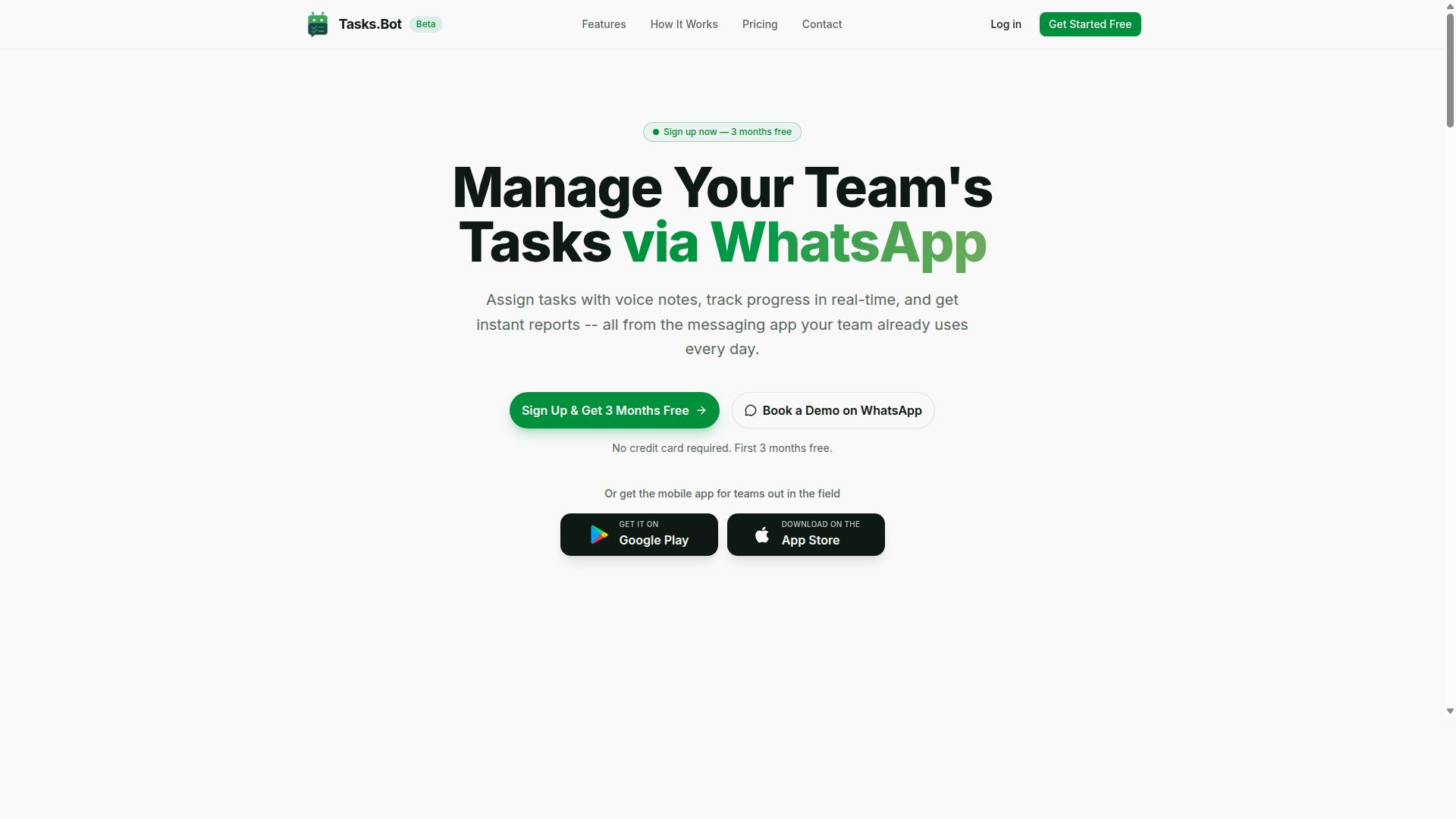
Tasks.Bot is a task management platform that operates entirely within WhatsApp, allowing teams to assign tasks, track progress, and receive reports without leaving the messaging app. Instead of asking workers to learn another dashboard, it meets them in the chat tool they already open every day.
The core value proposition is frictionless adoption. There are no new app installs required and no separate account creations for team members to manage. That removes the two biggest barriers to rolling out any new task allocation software: training time and resistance to change.
Behind the chat interface, the platform applies artificial intelligence to interpret how people actually write and speak. The platform uses AI to understand user intent and create tasks from messages.
Voice notes work the same way. A supervisor can speak an instruction on the move, and the platform captures it as an actionable item rather than a message that gets lost in the scroll. This matters for workflow automation because data entry stops being a separate step.
For teams that spend their day away from a desk, Tasks.Bot also offers a mobile app for field teams. The service is currently in beta and includes a free trial period, so teams can evaluate whether WhatsApp-native task management fits their operation.
Taken together, these pieces position Tasks.Bot less as another project management tool and more as an AI team assignment automation layer that lives inside an existing conversation. The sections below look at who benefits most from that approach.
Who Tasks.Bot Serves: WhatsApp-First Teams and Field Staff
Tasks.Bot is designed for teams that already rely on WhatsApp for communication, particularly those with field staff who need task management, attendance tracking, and payroll-ready hours. If your coordination already happens in group chats, the platform slots into that habit rather than competing with it.
The site notes that hundreds of teams are already using the service. That figure points to a specific profile: small and mid-sized operations where team collaboration runs on messaging, not on enterprise software suites.
Field-based workers are the clearest fit. Their day involves moving between locations, receiving instructions remotely, and reporting back without sitting at a computer. A chat-based system removes the gap between where work happens and where it gets recorded.
For these teams, the platform addresses needs that generic tools handle poorly:
- Tasks on a map, so location-based work is visible rather than described in text
- Face-verified attendance, which supports accountability for distributed crews
- Payroll-ready hours, so time data flows toward admin without manual reconstruction
- Task tracking in chat, keeping updates where managers already read them
The common thread is operational efficiency for teams without dedicated IT support. There is no rollout project, no per-seat onboarding campaign, and no parallel system to maintain alongside the chat app everyone already uses.
Managers in these settings also tend to wear several hats. Someone handling scheduling, supervision, and reporting in the same afternoon benefits when assignment, attendance, and hours live in one place instead of three.
That is why the audience is narrow by design. Tasks.Bot is not aimed at every organization, but for WhatsApp-first teams with mobile workers, the fit is direct: the tool adapts to the workflow instead of demanding the reverse.
Is Tasks.Bot Good for AI Team Assignment Automation? The Direct Answer
Yes, Tasks.Bot is a capable tool for AI team assignment automation, using AI to understand user intent and create tasks within WhatsApp. It earns that verdict by removing two of the biggest friction points in task allocation software: manual coordination and app switching. Team members do not need to install anything or create new accounts, because everything happens inside the messaging app they already use every day.
The strengths are clear. Tasks.Bot uses artificial intelligence to understand natural language and voice notes for task creation, then handles automatic task assignment, smart deadline reminders, approvals and automations, and instant reports. For teams that manage field staff, it adds face-verified attendance, live GPS tracking, tasks on a map, and shifts, leave, and hours management. Enterprise-grade encryption protects conversations and task data, which are never shared or used for training. A 3-month free trial with no credit card required makes evaluation low risk.
There are honest limitations worth weighing. The experience is built around WhatsApp, so an organization that avoids that platform will not get full value from the native integration. Some capabilities, such as automatic task assignment, sit at the more advanced end of the product, which means teams should test them during the trial rather than assume a fit. Android and iOS apps with push notifications, voice capture, and a home screen widget do extend access beyond the chat window, but WhatsApp remains the core surface.
On balance, the strengths outweigh the constraints for most teams. The platform reduces manual coordination and bottlenecks by letting artificial intelligence handle the routing work, while workforce features like attendance verification and live tracking serve field-heavy operations that generic project management tools often ignore. The sections below explain how the assignment engine works.
How Tasks.Bot's AI Handles Task Assignment and Natural Language Input
Tasks.Bot's AI engine interprets natural language and voice notes to create tasks, then handles automatic task assignment. Understanding each step helps you judge whether intelligent assignment will actually fit how your team operates.
The workflow unfolds in four stages:
- Task creation. A manager sends a message or voice note in plain language, for example "fix the leaky faucet at the Riverside site tomorrow." No forms, dropdowns, or project setup screens are involved.
- Parsing. The AI works from the intent behind the message rather than rigid keywords.
- Assignment logic. The system routes the task to an owner. In the faucet example, an available plumber with the right skills receives it instead of an overloaded generalist.
- Deadline and priority handling. Smart deadline reminders fire at the right moment, and priority ranking keeps urgent work visible. Approvals and automations move tasks through sign-off without extra chasing.
This is where task routing stops being a human bottleneck. Instead of a manager manually checking who is free, who has the right skills, and who is already stretched, the engine handles the assignment. The result is steadier capacity planning and fewer stalled handoffs.
Two practical notes. First, the quality of automatic assignment depends on your team data being reasonably accurate, so keep skills and availability current. Second, use the 3-month free trial to run real tasks through the system and confirm the routing decisions match your expectations. Voice capture, push notifications, and the home screen widget in the Android and iOS apps make it easy to submit and receive tasks without opening a dashboard, which keeps employee productivity high for teams that live in chat all day.
Key AI and Automation Features That Set Tasks.Bot Apart
Tasks.Bot offers a suite of AI-powered features that streamline task management, from voice-activated task creation to automated reporting, all within WhatsApp. Unlike traditional project management platforms that require teams to learn a new interface, Tasks.Bot works inside the messaging app most people already use every day.
This matters for AI team assignment automation because adoption is often the biggest obstacle. When team members do not need to install anything or create new accounts, task allocation software actually gets used instead of ignored.
The platform uses artificial intelligence to understand user intent and create tasks directly from messages.
For teams with field staff, the difference is even sharper. Office-based project management tools assume everyone is at a desk. Tasks.Bot assumes they are not, which shapes every feature described below.
Voice Notes, Smart Deadlines, Approvals, and Instant Reports
Tasks.Bot's voice note task creation allows users to simply speak a task in natural language, which the AI converts into an actionable item with smart deadlines and automated reminders. For field staff working with their hands or on the move, this removes the friction of typing out details on a small screen.
Smart deadline reminders build on that foundation. The system sends reminders so nothing slips through unnoticed.
Approvals and automations add structure to the flow. A task can require sign-off before it moves forward, and completing one step can trigger the next through workflow automation. This reduces the back-and-forth that usually happens over chat threads.
Instant reports give managers a real-time view of task status and team performance without chasing updates. Instead of compiling spreadsheets, they receive reporting directly, which supports faster decisions on workload balancing and priority ranking.
Together these features cut down on manual entry errors and the time lost to status-checking messages. A supervisor who once spent an hour confirming progress can instead read a report and act on it.
Field Team Tools: Tasks on a Map, Live Day Tracker, Face-Verified Attendance
For field teams, Tasks.Bot provides specialized tools including a map view of tasks, a live day tracker for monitoring progress, and face-verified attendance to ensure accountability. These features address the visibility gap that desk-based project management software typically leaves open.
Tasks on a map geolocate each assignment, which helps with routing and scheduling. A manager can see where work is clustered and plan the day accordingly, rather than relying on phone calls to figure out who is near which job.
The live day tracker offers real-time visibility into field staff progress and location. This supports real-time updates and makes it easier to spot a stalled task before it becomes a missed deadline.
Face-verified attendance confirms that the right person is on site, which matters for payroll accuracy and compliance records. It replaces sign-in sheets and guesswork with a verified check-in.
All of this runs through the WhatsApp interface and the Tasks.Bot Android and iOS apps, which include push notifications, voice capture, and a home screen widget. Because the tools live where the conversation already happens, field teams get task routing and tracking without switching between systems.
Pricing and Plans: What AI Team Assignment Automation Costs
Tasks.Bot offers a single 'Full Access' plan with all features included, priced at ₹200 per member per month or ₹1,200 per member per year, available in Indian Rupees and US Dollars. There are no tiers, no locked modules, and no upgrade path to worry about. Every team that subscribes gets the complete AI team assignment automation toolkit from day one.
That single-plan structure matters more than it might seem. Many task allocation software products split intelligent assignment, workload balancing, and reporting across separate packages, which forces buyers to guess which tier they actually need. Tasks.Bot removes that guesswork entirely. One plan, one price per member, and every capability is switched on.
| Plan | Price | Billing | Features |
|---|---|---|---|
| Full Access (Monthly) | ₹200 per member per month | Monthly | All features included |
| Full Access (Annual) | ₹1,200 per member per year | Annual | All features included |
The annual option is where the real value sits. At ₹1,200 per member per year, a team saves 50% compared to paying monthly, which works out to ₹1,200 saved per member every year. For a ten-person team, that is a meaningful line item rather than a rounding error.
Currency is selectable at checkout, with Indian Rupee and US Dollar options listed under 'Select currency'. Teams outside India can therefore budget in dollars without manual conversion. It is a small detail, but it keeps procurement simple for distributed companies.
New users also get 3 months free, with no credit card required and the ability to cancel anytime. That trial period is long enough to judge whether intelligent assignment actually reduces the manual coordination load on a project manager, rather than just shifting it somewhere else.
Scalability follows the same logic. Because pricing is per member, cost grows in step with headcount and nothing else. A five-person startup and a fifty-person department pay the same rate per seat, and the platform does not gate capacity planning, workload balancing, or real-time updates behind a higher tier as a team expands.
When weighing cost against value, the comparison is straightforward. Manual coordination consumes a substantial share of a manager's week: chasing availability, matching skills to tasks, and reshuffling priorities when deadlines move. AI team assignment automation absorbs much of that overhead. If the software recovers even a few hours of administrative time per member each month, the per-member fee is quickly covered by employee productivity regained and operational efficiency gained.
It is also worth noting what the price does not include: hidden add-ons, per-project fees, or charges for additional automation runs. The published rate is the rate. For teams comparing task allocation software on total cost of ownership rather than sticker price, that predictability is often the deciding factor.
Trust Signals: Beta Status, Encryption, and Early Adoption
Tasks.Bot is currently in beta, which means it is actively being improved, but it also has a growing user base of hundreds of teams and employs encryption to protect data. For anyone evaluating AI team assignment automation, that combination raises fair questions. What does beta status actually mean for day-to-day use? How safe is your project data? And can you trust a platform that is still evolving?
This section answers those questions directly, using only what Tasks.Bot publicly states about itself. The goal is transparency, not hype, so you can decide whether the platform fits your team's comfort level and risk tolerance.
Beta status is a stage, not a warning sign. Software in beta is under active development, which means features can change, and occasional bugs are possible. That is the honest trade-off of any early-stage product.
The upside is real too. Teams joining during beta often get a closer look at how the product develops, and feedback can influence what gets built next. If shaping a young AI team assignment tool matters to you, beta is not a drawback. It is an opportunity.
Encryption protects your data. Tasks.Bot employs encryption to protect data, a baseline expectation for any task allocation software handling project details, team rosters, and deadlines. When AI handles workload balancing and intelligent assignment, sensitive information moves through the system constantly. Encryption is what keeps that movement secure.
Beyond encryption itself, it helps to ask any vendor how data is stored, who can access it, and what happens when you leave. Tasks.Bot states that it employs encryption, and that is a meaningful starting point for a security conversation.
Hundreds of teams already use Tasks.Bot. Early adoption at that scale is a trust signal in itself. Teams do not hand over project management and resource scheduling to a platform they distrust. A growing user base during beta suggests the core value is landing, even while the product matures.
If you want to see the platform before committing, Tasks.Bot offers a Book a Demo on WhatsApp option. That lets you ask questions directly and judge the fit for yourself rather than relying on marketing copy alone.
A refund policy lowers the risk of trying it. The site mentions a refund policy in the footer, which matters when evaluating any tool in beta. If the platform does not suit your workflow, you have a documented path to recover your spend.
For a deeper look at whether Tasks.Bot is good for AI team assignment automation, weigh the trade-offs honestly:
- Beta stage: ongoing development and possible bugs, balanced by influence over the roadmap
- Encryption: data protection as a stated security measure
- Early adoption: hundreds of teams already on board
- Refund policy: a stated safety net if the tool is not right for you
The verdict is straightforward. Tasks.Bot is a legitimate, actively developed platform for AI team assignment automation, with encryption in place, a growing user base, and a refund policy that reduces the cost of finding out whether it works for your team. Try it with a clear understanding of the beta phase, and use the demo and refund options to evaluate it on your own terms.
Who Should Use Tasks.Bot for AI Team Assignment Automation
Tasks.Bot is ideal for small to medium-sized teams that use WhatsApp for communication, especially those with field staff or remote workers who need task management, attendance tracking, and automated reporting. The service is already used by hundreds of teams, which suggests it fits a specific and well-defined type of operation rather than trying to serve everyone.
If your team already lives inside WhatsApp, the appeal is obvious. There is no new app to learn and no separate inbox to check. Task assignment, updates, and reporting happen in the same place your staff already talk to each other every day.
Below are the three groups that get the most value from Tasks.Bot, plus a clear look at who should probably look elsewhere.
Teams that use WhatsApp as their main communication tool. For these teams, Tasks.Bot removes the friction of adopting yet another platform. Managers can assign work, staff can confirm or update status, and attendance can be logged without leaving the chat environment people already trust. This matters most for smaller businesses where software adoption is the biggest hurdle, not the technology itself.
Businesses with field staff. Maintenance crews, delivery drivers, and field sales reps rarely sit at a desk. They need task management, attendance tracking, and payroll-ready hours captured as they move between jobs. Tasks.Bot is built around exactly this combination, which makes it a natural fit for anyone coordinating people who are not in one office.
Industries that tend to match this profile include:
- Home services such as plumbing, electrical, cleaning, and repair work, where jobs are dispatched to technicians on the move
- Logistics and delivery, where drivers need assigned routes, status updates, and verified attendance
- Field sales, where reps visit clients and managers need visibility into activity and hours
- Maintenance and facilities, where recurring jobs and location checks matter
Managers who want to cut manual coordination. If a manager currently assigns work through group chats, phone calls, and spreadsheets, Tasks.Bot replaces that patchwork with a single flow. Attendance, task status, and hours feed into reporting without someone chasing updates by hand.
That reduction in manual coordination is where operational efficiency improves most. Fewer messages get lost, fewer jobs get double-booked, and payroll hours come from tracked records rather than memory.
It is equally important to be honest about fit. Tasks.Bot is not the right choice for every team.
Teams that do not use WhatsApp will not get the core benefit. The whole value proposition rests on working inside the messaging tool your staff already use. If your team communicates on Slack or Microsoft Teams, or through tools like Trello, Asana, Jira, ClickUp, or Monday, the WhatsApp-first design is a mismatch rather than an advantage.
Businesses needing extensive integrations with a wider software stack should also weigh their options carefully. Teams that depend on deep API connectivity, complex project management platforms, or heavy workflow automation across many systems may find a WhatsApp-centered tool too narrow for their needs.
The clearest verdict: Tasks.Bot is a strong fit for WhatsApp-based teams with field or remote staff who need task management, attendance tracking, and payroll-ready hours in one place. For teams outside that profile, a different category of task allocation software will serve them better. Knowing which group you fall into is the fastest way to decide.
Final Verdict: Is Tasks.Bot Worth It?
Tasks.Bot is a compelling solution for teams seeking AI-powered task assignment within WhatsApp, offering a generous feature set at a competitive price, though its beta status means some rough edges may remain.
The case for Tasks.Bot rests on a simple idea: meet teams where they already communicate. Instead of forcing staff to adopt yet another dashboard, it brings AI team assignment automation into WhatsApp itself. For WhatsApp-first teams, that removes a major adoption barrier.
Its strengths cluster around four areas:
- WhatsApp integration: task assignment happens inside the messaging app teams already use daily
- AI-driven assignment: artificial intelligence handles the routing decisions that normally eat up a manager's time
- Field team tools: built with mobile and on-the-ground staff in mind, not just desk workers
- Affordable pricing: a competitive cost structure that keeps it accessible for smaller teams
These combine into practical gains: less manual coordination, faster task routing, and better workload balancing across a distributed group. For field teams especially, where staff may rarely sit at a laptop, this matters a great deal.
The honest caveats are worth stating plainly. Tasks.Bot is in beta, so some rough edges may remain as the product matures. Its value also depends heavily on WhatsApp itself. A team that lives in Slack, Microsoft Teams, or a full project management suite may find the fit less natural.
Where does that leave the verdict? For WhatsApp-first teams, particularly those managing field staff, Tasks.Bot is worth trying. It targets a real gap in task allocation software: tools that assume everyone is chained to a desktop. The AI-driven assignment and mobile-first design address genuine pain points around deadline management, priority ranking, and operational efficiency.
Teams weighing it against heavier platforms should consider their own workflow. If communication already runs through WhatsApp, the low-friction setup and competitive pricing make the decision straightforward. If your operation is built around Slack integration, Trello, Asana, Jira, ClickUp, or Monday, evaluate whether WhatsApp can serve as your coordination hub first.
To learn more or book a demo on WhatsApp, reach out by phone at +91 97143 42522 or email [email protected].
Frequently Asked Questions
What exactly does Tasks.Bot do for team task assignment?
Tasks.Bot is a task management platform that works inside WhatsApp, letting teams assign tasks, track progress, and receive reports without leaving the app. It uses AI to understand natural language and voice notes, so you can create tasks conversationally. It also offers a mobile app for field teams, plus features like automatic task assignment, smart deadline reminders, approvals, and instant reports.
Do my team members need to install new software or create accounts?
No. Tasks.Bot operates entirely within WhatsApp, so team members don't need to install anything or create new accounts to get started. This makes it especially practical for teams that already run their day-to-day communication on WhatsApp. There's also a mobile app available for field teams who need it.
How does the AI actually help with assigning tasks?
Tasks.Bot uses AI to understand natural language and voice notes, so you can create and assign tasks simply by speaking or typing as you normally would. It also supports automatic task assignment, smart deadline reminders, and approvals and automations. This reduces the manual setup work that usually comes with task management tools.
Is Tasks.Bot suitable for teams with field staff?
Yes. Tasks.Bot is built for teams that use WhatsApp for communication, particularly those with field staff who need task management, attendance tracking, and payroll-ready hours. Features like face-verified attendance, tasks on a map, and live day tracking are designed with field operations in mind. The site mentions hundreds of teams already using the service.
How much does Tasks.Bot cost?
Tasks.Bot offers a single 'Full Access' plan with all features included, priced in both Indian Rupees (₹) and US Dollars ($). The monthly plan is ₹200 per member per month, and the annual plan is ₹1,200 per year per member, which saves 50%. You can book a demo on WhatsApp to see it in action before committing.
Is Tasks.Bot available in my country, and how do I get started?
Tasks.Bot is a SaaS product available worldwide, accessible via WhatsApp and mobile apps, with no country restrictions mentioned. The easiest way to get started is to book a demo on WhatsApp directly from the website. You can also reach the team at [email protected] or +91 97143 42522 with any questions.
Recommended Resources: