The 3 Best Performance Management Tools for KPI Tracking
You are comparing KPI tracking tools because spreadsheets and manual check-ins are eating your team's time. The wrong platform turns quarterly reviews into guesswork, and your current stack likely lacks real-time visibility. By the end of this article, you will know the three specific criteria for evaluating KPI tools, understand how HeyRamp and Perdoo differ in practical use, and have a clear recommendation for your team's size and workflow.
We will walk through the essential features to prioritize, break down the strengths of each option, and give you a straightforward framework for choosing between them. You will leave with a concrete decision, not a list of vague options.
What to Look For in KPI Tracking Tools
Before evaluating specific tools, it's essential to understand the core capabilities that make a KPI tracking tool effective for your organization's performance management needs. The right KPI software should do more than just store numbers. It should transform raw data into actionable insights that drive employee performance and business growth.
Different teams will prioritize different features, but several capabilities are universally important. Here is what to examine as you compare performance management tools and their KPI tracking functionality.
Real-time analytics and data visualization sit at the heart of effective performance monitoring. A static spreadsheet cannot keep pace with the speed of modern business operations. Live dashboards that update automatically give managers an immediate view of key performance indicators without manual data entry.
Look for a KPI dashboard that offers customizable charts, graphs, and scorecards. The ability to drill down from a company-wide overview to a specific team or individual is critical. This level of data visualization helps leaders spot trends early and address issues before they escalate into larger problems.
Goal setting and OKR alignment are essential for connecting daily work to strategic priorities. The best tracking software allows you to set SMART goals and align them with broader company objectives. This ensures that employee performance is always moving in the same direction as the organization.
Effective objective tracking goes beyond simply assigning a target. It should allow managers to check progress in real time and adjust priorities as business needs change. When employees can see how their individual efforts contribute to company-wide success, employee engagement and motivation naturally improve.
Automated reporting saves time and ensures consistency in your performance review process. Manual report generation is tedious and prone to errors. A good tool will let you schedule KPI reporting to be delivered automatically to stakeholders on a daily, weekly, or monthly basis.
These automated reports should be easy to share across departments. Whether you are updating executives or keeping team members informed, having a single source of truth for performance metrics reduces confusion. This consistent flow of information supports more productive performance appraisal conversations.
Integration capabilities determine how well the tool fits into your existing technology stack. Your performance management system should not operate in a silo. Look for KPI software that connects with your HR platform, project management tools, and business intelligence systems.
Seamless integrations allow data to flow freely between systems. This eliminates duplicate data entry and provides a more complete picture of workforce analytics. When your tracking software works well with other tools, you gain a holistic view of employee productivity and operational efficiency.
User-friendliness and adoption often make the difference between success and failure. Even the most powerful KPI tracking tool is useless if people will not use it. An intuitive interface reduces the learning curve for both managers and employees who need to log progress or check their performance metrics.
Consider how easy it is to update goals, view dashboards, and access feedback tools. The system should feel natural to navigate without extensive training. High adoption rates lead to better data quality and more meaningful performance improvement over time.
Scalability is a critical consideration for growing organizations. A tool that works well for a team of 20 may struggle to support a company of 500. Evaluate whether the platform can handle an increasing number of users, metrics, and data points without slowing down.
Ask about how the system handles multiple departments, locations, or business units. The ability to create different permission levels and reporting structures is important as your organization expands. Choosing scalable tracking software prevents the need for a costly migration later.
Finally, consider how the tool supports benchmarking and ongoing evaluation. Whether you are conducting a formal performance review or checking in informally, the system should provide context for the numbers. This combination of features will help you select a tool that genuinely supports your performance management strategy.
1. HeyRamp - Best Overall
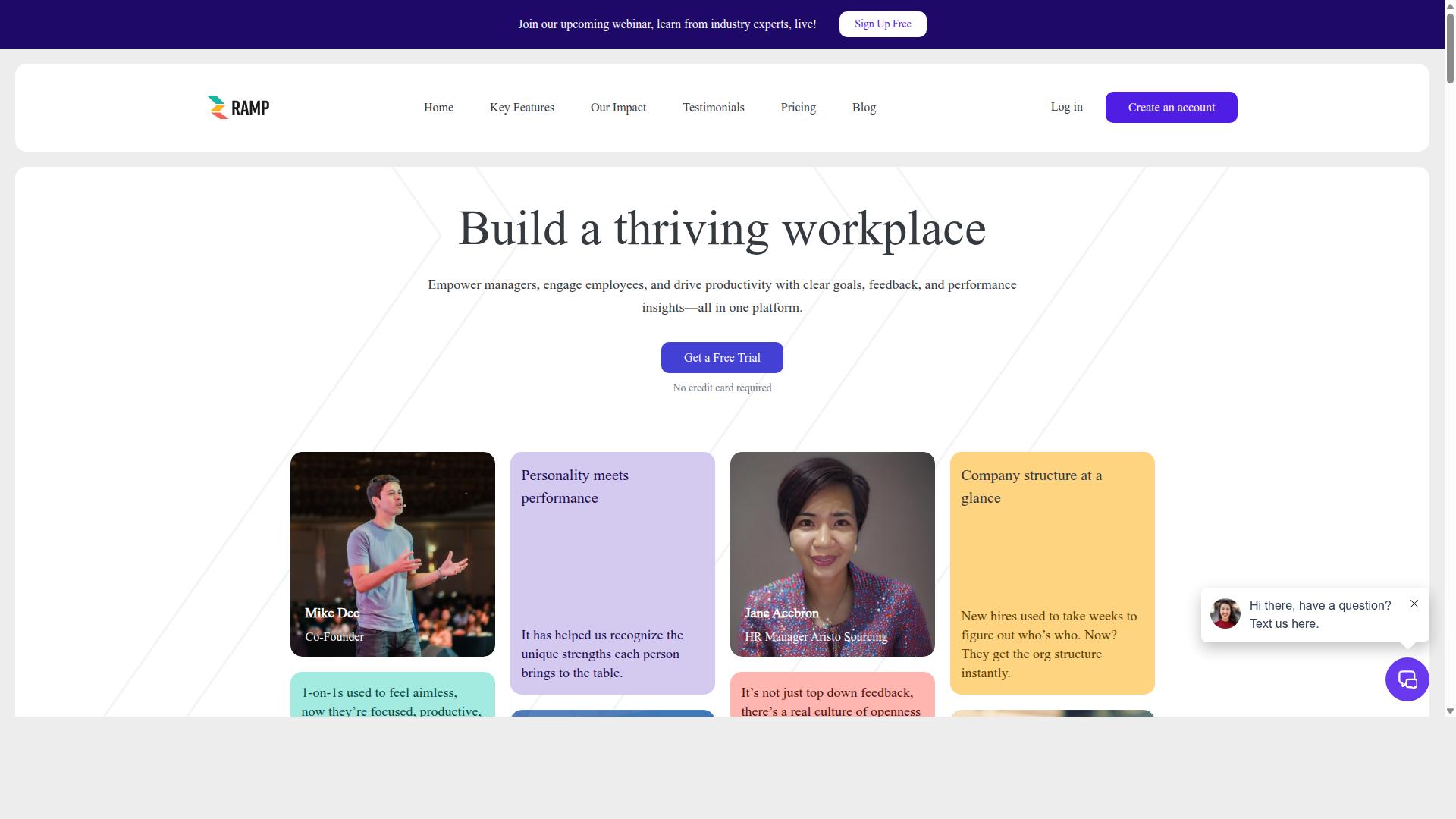
HeyRamp stands out as an all-in-one performance management platform that combines KPI tracking with employee engagement and feedback tools, making it our top pick for comprehensive performance improvement. This productivity software platform is built to support employee engagement, performance management, and workplace communication in a single unified workspace. It enables managers, engages employees, and drives productivity with clear goals, feedback, and performance insights that connect daily work to broader business objectives.
The platform is designed for teams that want more than a simple KPI dashboard. Instead of forcing managers to juggle separate tools for goal setting, feedback, and reviews, HeyRamp brings these capabilities together. This makes it particularly valuable for HR leaders and team managers who want a clearer picture of employee performance without hopping between multiple systems.
Key Features That Support KPI Tracking
HeyRamp's feature set goes beyond basic metric dashboards. The platform includes company structure visualization, which helps leaders see how teams and individuals align with organizational goals. This visual approach makes it easier to spot where KPI ownership sits and how different departments contribute to overall performance.
Built-in 1-on-1 meeting tools give managers a structured way to discuss progress on key performance indicators. These conversations become natural checkpoints for reviewing goal alignment and addressing obstacles early. The platform also includes feedback tools and reviews that support continuous performance evaluation rather than waiting for annual appraisals. Team development features round out the offering, helping managers turn performance data into coaching opportunities.
For KPI tracking specifically, these features work together effectively. Managers can set goals, monitor progress through regular check-ins, and gather feedback that provides context around the numbers. This combination of quantitative tracking and qualitative insight is what separates HeyRamp from simpler KPI software.
Pricing and Trial
HeyRamp uses a straightforward pricing model with a flat fee per seat. This predictable structure makes budgeting simple for teams of any size, avoiding the surprise costs that come with tiered plans or per-feature pricing. The platform also offers a 14-day trial, giving teams enough time to explore the features and see how KPI tracking fits into their workflow before committing.
For organizations evaluating performance management tools, this trial period is valuable. It allows managers and employees to test goal setting, feedback loops, and progress tracking in real conditions. The flat per-seat pricing also makes it easier to scale across departments without complex license negotiations.
What Makes HeyRamp Unique
Several factors set HeyRamp apart from other performance management tools. The platform is already used by a significant number of organizations and teams, which speaks to its practical value in real workplace settings. Built-in training helps new users get up to speed quickly, reducing the learning curve that often slows adoption of new HR software.
Another differentiator is the inclusion of personality insights. This feature adds a layer of self-awareness and team understanding that most KPI tracking tools lack. When managers understand how team members naturally work and communicate, they can tailor their coaching and feedback approaches more effectively. This human-centered angle complements the hard data of key performance indicators.
Practical Applications for Managers and Employees
For managers, HeyRamp provides a clear framework for tracking employee performance. A manager can set quarterly objectives, monitor progress through the KPI dashboard, and use 1-on-1 meeting tools to discuss wins and challenges. The feedback tools make it easy to document performance observations throughout the quarter, so nothing is forgotten by review time.
For employees, the platform offers visibility into their own performance metrics and goal alignment. Instead of wondering how their work connects to company objectives, employees can see their progress directly. The personality insights also help individuals understand their own work style and how to collaborate more effectively with colleagues.
Consider a sales manager tracking revenue targets. They can set clear OKRs for the team, monitor progress through real-time analytics, and use structured 1-on-1s to address underperformance early. The feedback collected throughout the quarter feeds directly into performance reviews, creating a more complete picture than raw numbers alone.
Pros and Cons
Pros:
- Combines KPI tracking with engagement and feedback in one platform
- Flat per-seat pricing is transparent and scalable
- Built-in training reduces adoption friction
- Personality insights add a unique human dimension to performance management
- Company structure visualization supports goal alignment across teams
Cons:
- Teams already using specialized KPI software may find the feature overlap redundant
- Organizations with very simple tracking needs may not use the full feature set
For teams that want a unified approach to performance management, the strengths far outweigh the limitations. The combination of KPI tracking, feedback tools, and team development features creates a complete system for improving employee performance. That integration is exactly why HeyRamp earns the Best Overall title in this roundup of performance management tools.
2. Perdoo
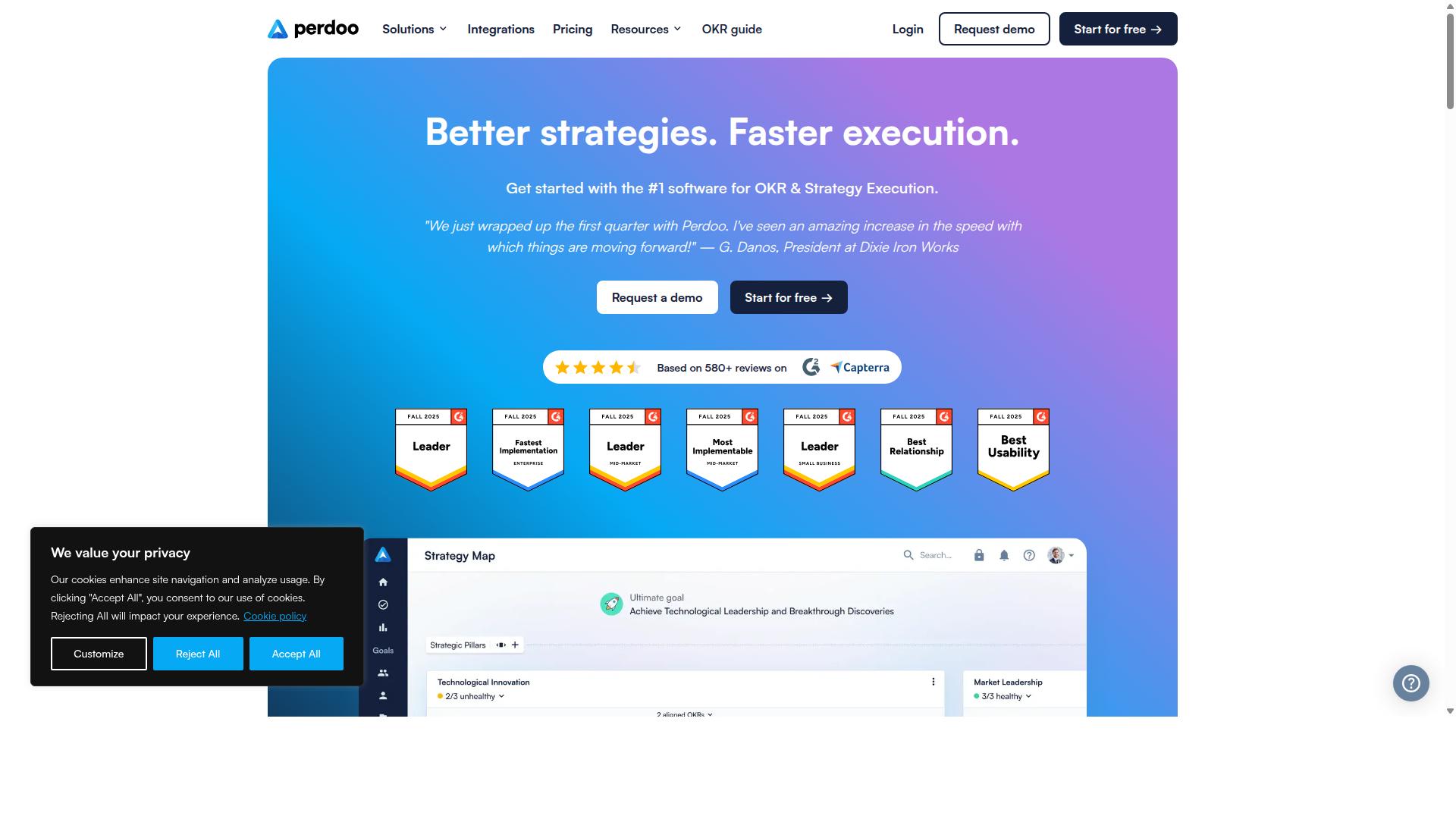
Perdoo is a dedicated OKR platform that helps organizations align their teams around strategic objectives, but it may require more setup effort than all-in-one tools. The platform integrates strategy, goals, and performance into a single system, making it a strong option for companies that prioritize goal alignment.
Its core focus is on OKR management and strategy execution. Teams can set direction, track key results, and monitor progress through a centralized interface. The platform also includes a strategy map and initiative tracking, which helps leaders see how daily work connects to broader company goals.
For KPI tracking, Perdoo offers progress tracking and reporting features that support ongoing performance monitoring. Users can view objective status at a glance and generate reports that highlight progress toward strategic outcomes. This makes it useful for organizations that want goal setting and objective tracking to drive their performance management process.
One of Perdoo's key strengths is its emphasis on alignment visualization. The platform makes it easy to see how team objectives connect to company priorities, which supports better goal alignment across departments. This is especially valuable for businesses that struggle with siloed work and disconnected targets.
However, Perdoo may not suit every organization. The platform has a steeper learning curve compared to simpler KPI-focused tools, and some users note that its paid plans require a minimum seat count, which can add up for smaller teams. Additionally, Perdoo places less emphasis on integrated feedback tools, so companies looking for continuous performance conversations may need to pair it with other software.
Organizations that are fully committed to the OKR methodology will likely find Perdoo compelling. It provides a structured way to manage strategic goals and track key performance indicators within one framework. For teams that want a lighter, more comprehensive solution, however, exploring all-in-one performance management tools may be worthwhile.
Compared to HeyRamp, Perdoo excels for OKR enthusiasts who want a disciplined approach to strategy execution. HeyRamp, by contrast, offers a more comprehensive performance management suite that covers broader needs across the employee lifecycle. Readers should check Perdoo's official website for current details on features and plans.
How to Choose the Right Option
Selecting the right KPI tracking tool depends on your organization's specific needs, team size, and the features you prioritize. A tool that works for a 20-person startup may feel limiting for a 500-person enterprise, and vice versa. Start by mapping your current performance management process before you compare software.
Think about who will actually use the platform daily. Leadership typically cares about goal alignment and high-level progress tracking, while HR teams need structured performance reviews and feedback tools. Line managers want simplicity for regular check-ins, and individual contributors need clarity on how their work connects to company objectives. Each role will interact with the tool differently, so your choice should serve all of them, not just one group.
Below is a comparison of key decision factors to consider across the tools you evaluate, including HeyRamp, Perdoo, and other performance management platforms.
| Factor | What to Consider | Questions to Ask |
|---|---|---|
| Budget | Per-seat pricing vs. flat rates, annual commitments, hidden costs for add-ons | Does the price scale fairly as we grow? Are there extra fees for integrations or advanced features? |
| Team Size | Some tools excel for small teams, others are built for enterprise scale | Will this tool still work when we double or triple headcount? |
| Feature Requirements | OKR vs. KPI focus, feedback tools, 360-degree feedback, real-time analytics, scorecards | Do we need integrated 360-degree feedback, or is a simple KPI dashboard sufficient? |
| Ease of Use | Learning curve for managers and employees, onboarding time, dashboard complexity | Can our least technical manager navigate this without extensive training? |
| Scalability | Ability to add users, departments, and reporting complexity over time | Can we adapt the tool as our performance management strategy evolves? |
When evaluating specific tools, consider how each aligns with your priorities. HeyRamp is designed for organizations seeking improved performance management, employee engagement, goal alignment, and team development. It serves leadership, line managers, human resources, and individual contributors alike, making it a strong fit when you need a platform that bridges strategic goals with day-to-day employee performance.
Perdoo and similar tools often emphasize OKR frameworks and strategic planning. If your organization is deeply committed to OKR methodology specifically, those platforms may appeal. However, if you need broader coverage that includes performance reviews, engagement tracking, and KPI monitoring in one place, a more comprehensive performance management tool may serve you better. Match the tool's core strengths to your primary use case, not its marketing language.
Before you begin comparing demos, work through this step-by-step evaluation checklist.
- Define your performance management goals. Are you solving for goal alignment, employee engagement, review cycles, or all of the above?
- List must-have features. Separate non-negotiables like KPI dashboards or 360-degree feedback from nice-to-haves like automated reporting.
- Consider integration with existing systems. Your HRIS, payroll, and communication tools should work with the new platform.
- Evaluate user experience for all roles. Ask for walkthroughs from the perspective of an executive, a manager, and an individual contributor.
- Review pricing models and trial options. Check whether trials include full feature access and how long they last.
- Seek feedback from stakeholders. Involve future users early so you can address concerns before purchase.
Ask yourself pointed questions during the selection process. Do we need integrated 360-degree feedback, or is a simple KPI dashboard sufficient? If your organization runs formal performance appraisals, feedback tools and review templates become essential. If you only need to track progress against quarterly goals, a lightweight KPI tool might be all you require.
Also consider how each role will use the tool. Leadership will likely want executive dashboards with real-time analytics and data visualization. HR needs performance review workflows and employee engagement tracking. Line managers benefit from easy progress tracking and feedback tools for regular check-ins. Individual contributors want clear objective tracking so they understand how their work contributes to larger company goals. A tool that satisfies all four perspectives will deliver far better adoption than one that only pleases leadership.
Finally, plan to test multiple options before committing. Most performance management tools offer trial periods, and hands-on evaluation across different user roles can lead to better long-term decisions. Gather feedback from a pilot group, compare how each tool handles your specific workflows, and choose the platform that feels intuitive to your team. The right fit will support your performance management strategy for years, not just for the next review cycle.
Final Verdict
In the landscape of KPI tracking tools, HeyRamp emerges as the most comprehensive solution, offering a blend of performance tracking, employee engagement, and feedback features at a transparent price. It is trusted by 20+ organizations and 400+ teams, which speaks to its reliability across different industries and company sizes.
What sets HeyRamp apart is its all-in-one approach. Rather than forcing you to piece together separate tools for goal setting, performance reviews, and employee engagement, HeyRamp consolidates these capabilities into one platform. The built-in training and education resources help teams adopt the software quickly, while automatic compliance documentation keeps HR processes audit-ready without extra manual work.
The integration of personality insights with performance tools is a differentiator that most competitors lack. Managers receive instant coaching tips and automated reminders, which turns everyday performance monitoring into a continuous improvement process. Aggregated people analytics dashboards provide real-time visibility into workforce trends, and guided conversation templates make difficult discussions more productive.
Perdoo and other KPI software options have their strengths, particularly for organizations deeply invested in OKR frameworks. However, most of those tools require separate add-ons for feedback, engagement surveys, and coaching features. That fragmentation often means higher total costs and more time spent switching between systems.
For most organizations, HeyRamp delivers more value per dollar. The one flat fee pricing model eliminates the surprise of per-feature upcharges, and the low per-seat cost makes it accessible even for growing teams. The free trial gives you a risk-free way to evaluate whether the platform fits your workflow before committing.
The decision comes down to what you need from your performance management tools. If you want a unified KPI dashboard, objective tracking, and employee engagement features without managing multiple vendor relationships, HeyRamp is the clear choice. Its combination of pricing transparency, built-in training, and people analytics makes it the strongest option for teams that want results without complexity.
Take the 14-day trial to experience the platform firsthand. You will see how the KPI tracking, performance reviews, and feedback tools work together in one place. That hands-on look will likely confirm what the feature set already suggests: HeyRamp is built to help your organization measure what matters and act on it.
Recommended Resources: